One earthquake every 36 hours: Life on top of the Region of Murcia's fault lines
More than 6,100 earthquakes have hit the Region since 1900, but most go unnoticed
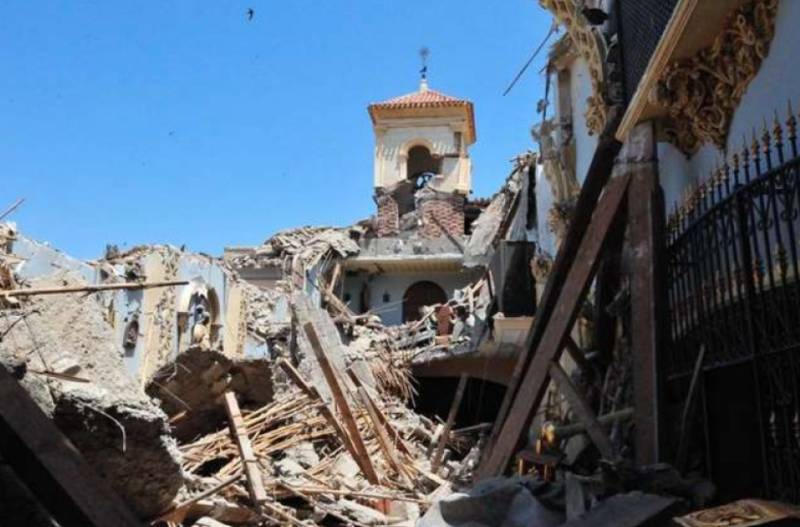
Archive image of the aftermath of the Lorca earthquake in May 2011
The Region of Murcia has recorded an earthquake roughly every 1.5 days since 2020, according to figures held in the National Geographic Institute's (IGN) seismic catalogue. The vast majority go completely unnoticed, but the numbers reveal just how restless the ground beneath this corner of Spain really is.
The IGN has tracked every located earthquake in the Region since 1900, when the first entry in the catalogue was recorded near Mazarrón in the early hours of March 9 that year. Since then, more than 6,140 earthquakes have struck the Region of Murcia, out of over 204,000 recorded across the whole of Spain. So far in 2026 alone, the Region has already passed 260.
Most of this activity is concentrated along a single stretch of geological fractures running through the heart of the Region, centred on the Alhama de Murcia fault. Aledo alone has been the epicentre of 995 earthquakes, roughly one in every six recorded in the Region's history, thanks to the area's tendency to experience swarms of small tremors over just days or weeks.
Geologist Raúl Pérez López, from the Geological and Mining Institute of Spain (IGME-CSIC), explained that the Region's defining feature is "active faults that can trigger earthquakes of magnitude above 6."
The Guadalentín Valley fault, in particular, has been active for millions of years and runs to a depth of at least 20 kilometres, even though most earthquakes along it start much closer to the surface, with half occurring less than two kilometres down.
The sharp rise in recorded earthquakes over the decades isn't a sign the ground is becoming more active. It's down to better detection. In the first decade of the 1900s, only eight earthquakes were located in the Region of Murcia, compared with 2,342 in 2010 alone, as sensors became sensitive enough to pick up tremors too small for anyone to feel.
The average magnitude of recorded earthquakes has dropped from 3.5 before 1980 to just 1.4 since 2010, while the number of quakes of magnitude 3 or higher, big enough to be picked up in any era, has stayed fairly stable for 50 years, at between 20 and 44 per decade.
Even so, the Region of Murcia hasn't been immune to real damage. The worst earthquake in living memory struck near Lorca on May 11, 2011, registering a magnitude of 5.1 and an intensity of VII. Nine people died and hundreds of buildings were damaged, a toll that far outweighed the quake's modest magnitude. Experts put that down to its shallow depth of around four kilometres, an epicentre right on the edge of town, and buildings that were either poorly suited to the ground they stood on or already in a state of disrepair. A smaller tremor an hour and a half earlier had already sent residents out into the streets, likely preventing further casualties.
Lorca isn't the only town with painful seismic history. Cehegín was hit in 1948, Mula in 1999 and Bullas in 2002, all magnitude 5.0 or close to it, while a swarm near La Paca and Aledo in 2005 produced 486 earthquakes in just two months. Further back, a major series of tremors around the Vega del Segura in 1911, including at Lorquí and Las Torres de Cotillas, destroyed hundreds of rural homes and reached the highest intensity ever documented in the Region, and the same fault system is linked to a 1674 earthquake in Lorca that killed 30 people.
Scientists are now trying to get ahead of the next one. The IGME has installed 25 geophones along the 85 km length of the Alhama fault, using artificial intelligence to filter out background noise that would otherwise drown out real seismic signals.
A newer project is going a step further, monitoring cosmic radiation and gases such as carbon dioxide and radon inside the Sima del Vapor cave near Alhama de Murcia, after researchers noticed unusual emission patterns around the timing of past earthquakes.
There's still no reliable way to predict exactly when or where the next significant earthquake will strike. For now, in the Region of Murcia, the ground will keep moving, mostly quietly, every day and a half or so.


















 Spanish News Today
 Alicante Today
 Andalucia Today


 Geologist Raúl Pérez López, from the Geological and Mining Institute of Spain (IGME-CSIC), explained that the Region's defining feature is "active faults that can trigger earthquakes of magnitude above 6."
 Lorca isn't the only town with painful seismic history. Cehegín was hit in 1948, Mula in 1999 and Bullas in 2002, all magnitude 5.0 or close to it, while a swarm near La Paca and Aledo in 2005 produced 486 earthquakes in just two months. Further back, a major series of tremors around the Vega del Segura in 1911, including at Lorquí and Las Torres de Cotillas, destroyed hundreds of rural homes and reached the highest intensity ever documented in the Region, and the same fault system is linked to a 1674 earthquake in Lorca that killed 30 people.