















 Spanish News Today
 Alicante Today
 Andalucia Today


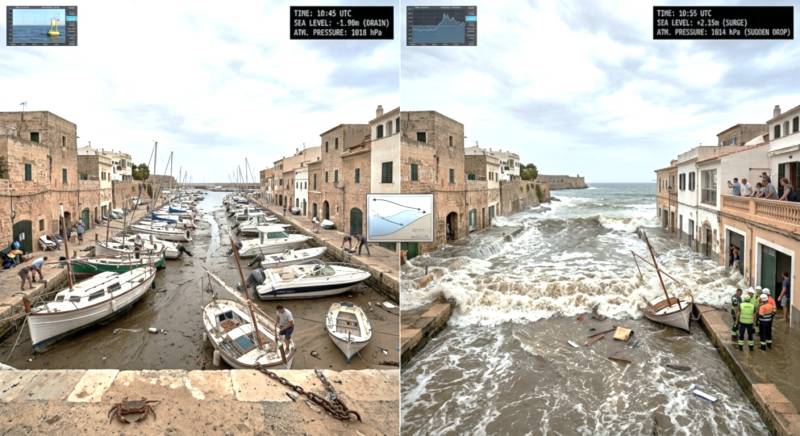
It might sound like something from a disaster film, but a meteotsunami is a real weather-related phenomenon, and one was seen in several parts of Spain’s Mediterranean coastline on August 24 and 25.
The sea suddenly moved in and out in places along the Costa Blanca and Valencia coast, with changes of up to 70 centimetres recorded in just a few minutes. Similar events were reported in Mallorca, while Menorca remained on alert for much larger fluctuations.
For anyone watching from the beach, the sudden movement of the water can be surprising. But what exactly causes it?
Despite the name, a meteotsunami isn't caused by an earthquake under the sea. Instead, it starts with what is happening in the atmosphere.
AEMET explains that atmospheric gravity waves can cause rapid changes in air pressure. When these pressure changes move across the Mediterranean, they can affect the surface of the sea, causing the water level to rise and fall.
In the right conditions, the effect can become much stronger. If the atmospheric waves move at a similar speed to waves on the sea, the two can interact and amplify the movement. The shape of the coastline can then make the changes even more noticeable.
This is particularly the case around shallow waters, bays and enclosed or partly enclosed ports, where the movement of the water can become concentrated.
In the Balearic Islands, these events are known as rissagas, and Menorca is particularly well known for them.
The unusual sea movement was reported at several points along the Valencian and Alicante coast, including Gandía, Cullera, Xàbia, Santa Pola, Elche, Torrevieja and Orihuela Costa.
In Gandía, the sea level changed by around 70 centimetres in just six minutes. The level went from 33.6 centimetres above the reference level at 9.06 am to 37.1 centimetres below it at 9.12 am.
The movement was also clearly visible in Xàbia, where the sea appeared to retreat before returning. In Dénia, changes of around 40 to 50 centimetres were recorded every few minutes, with strong currents making it more difficult for some boats to enter the port.
Further south, Santa Pola also saw a noticeable change. At Playa Lisa and Gran Playa, the sea suddenly pulled back, exposing parts of the seabed that would normally be covered, before quickly moving back towards the shore.
At Playa Lisa, the water reached the seafront and even made its way as far as Avenida Blasco Ibáñez. The Policía Local temporarily closed part of the road while the water level was high.
AEMET has recorded similar sudden changes in the past in Santa Pola, the Marina de Elche, Torrevieja and El Campello.
Mallorca experienced several rissagas on Monday, including at the ports of Alcúdia, Andratx and Sóller, as well as around Calvià.
Some of the most striking scenes were at Port d'Alcúdia, where the incoming water surprised people on the promenade and reached areas where restaurants had tables set up. The water spread across much of the sandy area close to the hotel and residential zone.
Mallorca did not have an active rissaga warning, as the phenomenon generally has a much smaller impact there than in Menorca.
Menorca is a different story. Ciutadella is considered the Balearic port most vulnerable to these meteosunamis because of its shape and orientation, which can amplify the movement of the water.
On Tuesday August 25, the port recorded a rise of 86.4 centimetres at 7.40 am. AEMET maintained an alert for possible sea level oscillations of up to 1.2 metres until midnight.
Meteotsunamis are generally short-lived and don't necessarily cause serious damage, but they can catch swimmers, boat owners and people close to the water completely by surprise.
AEMET classifies them as a rare marine phenomenon and encourages people who witness one to report it through its Sinobas project. These reports help meteorologists build a clearer picture of when these unusual movements occur and how they affect Spain's coastline.
Image: Artistic representation
staff.inc.ali
Sign up for the Spanish News Today Editors Roundup Weekly Bulletin and get an email with all the week’s news straight to your inbox
Special offer: Subscribe now for 25% off (36.95 euros for 48 Bulletins)
Read some of our recent bulletins:
Discount Special Offer subscription:
36.95€ for 48 Editor’s Weekly News Roundup bulletins!
Please CLICK THE BUTTON to subscribe.
(List price 3 months 12 Bulletins)